CRCST vs. CSPDT: Which Sterile Processing Certification Should You Get First?
NHNathan Hostetter · November 3, 2026 · 4 min read
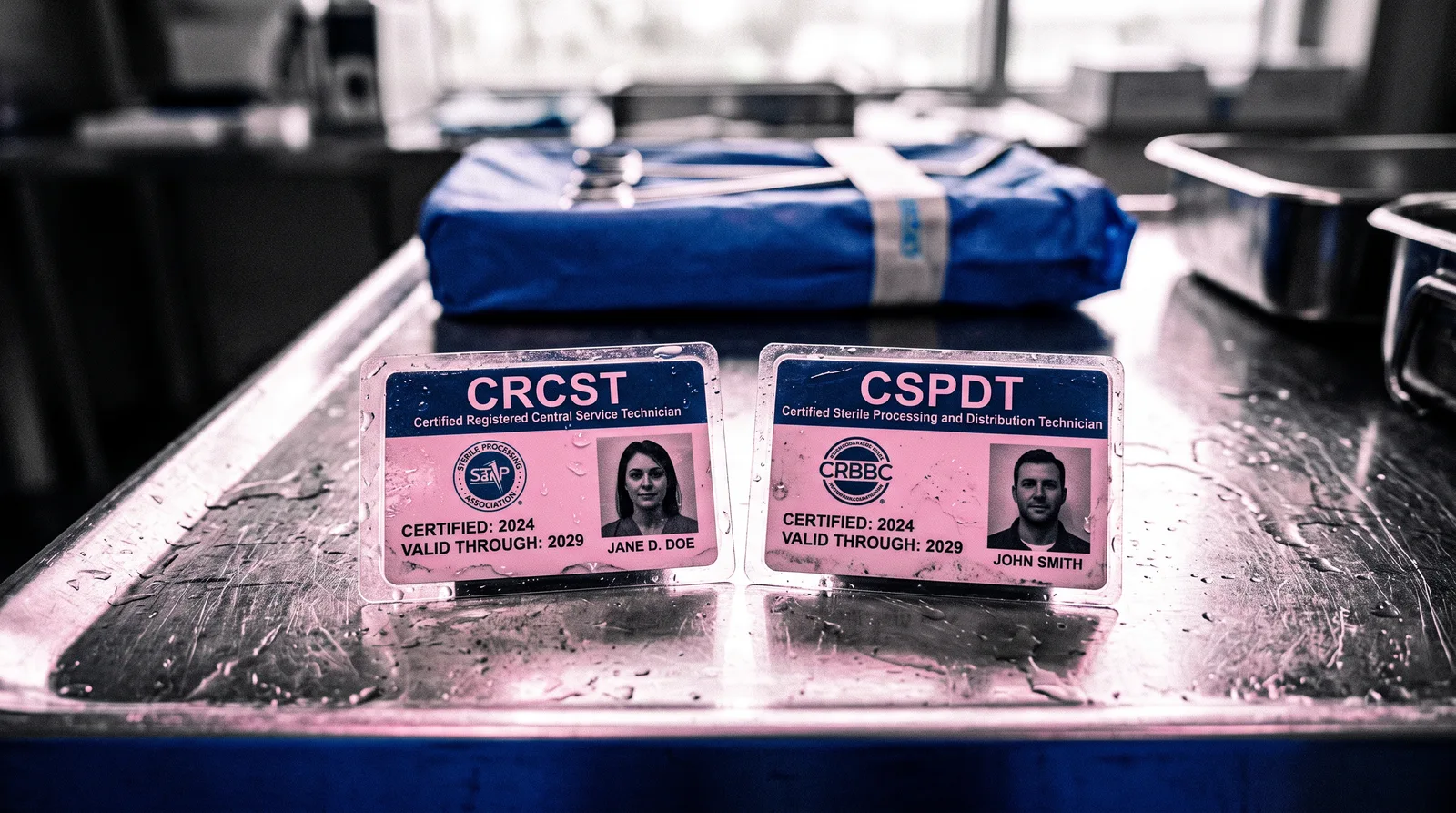
If you're new to sterile processing and you've started researching certifications, you've probably run into two acronyms that seem to be everywhere: CRCST and CSPDT. Both are nationally recognized entry-level credentials for sterile processing technicians. Both can open doors to better jobs and higher pay. And both require you to prove that you actually know what you're doing inside an SPD.
So which one should you pursue first?
The honest answer is: it depends on where you are right now. Let me break down each credential side by side so you can make a confident, informed decision.
What Each Credential Actually Is
The CRCST (Certified Registered Central Service Technician) is issued by HSPA — the Healthcare Sterile Processing Association. It has been around for decades and is widely considered the industry standard, particularly in hospital systems across the country.
The CSPDT (Certified Sterile Processing and Distribution Technician) is issued by CBSPD — the Certification Board for Sterile Processing and Distribution. It's the other major national body in this space and carries strong recognition, especially in certain regions and facility types.
Both credentials cover the same core competencies: decontamination, assembly and packaging, sterilization, and sterile storage and distribution. Neither is "better" in an absolute sense — but one may be a better fit for your situation.
Eligibility Requirements: Where the Real Difference Lives
This is often the deciding factor for beginners, so pay close attention.
CRCST (HSPA):
- Requires 400 hours of hands-on work experience in a sterile processing department
- You must complete the experience requirement before your certification is issued (you can sit for the exam first, but the credential won't be granted until hours are verified)
- HSPA offers a self-paced online curriculum you can study before or during your hours
CSPDT (CBSPD):
- Also requires 400 hours of work experience, but the documentation process and verification steps differ slightly
- CBSPD allows candidates to apply and test while actively accumulating hours in some pathways — worth confirming directly with CBSPD for your specific situation
- Some training programs (including my Sterile Processing Academy) issue a Certificate of Completion that CBSPD accepts as part of your application package
Practical takeaway: If you're currently working in an SPD — even as a new hire — both credentials are within reach. If you haven't started working yet, completing a structured training program first puts you in a strong position to apply the moment your hours are logged.
Exam Format: Know What You're Walking Into
CRCST Exam:
- 150 multiple-choice questions
- Administered through HSPA's testing partners
- Covers all central service domains plus a section on healthcare environment and professional development
- Exam fee: approximately $139 for HSPA members, higher for non-members
CSPDT Exam:
- 150 multiple-choice questions
- Administered at Pearson VUE testing centers (widely available across the US)
- Covers decontamination, assembly, sterilization, and sterile storage
- Exam fee: approximately $199
Both exams are comparable in difficulty. The content overlap is substantial because both are built around the same real-world SPD knowledge base. If you're well-prepared for one, you're largely prepared for the other.
Employer Recognition: What the Job Market Actually Sees
Here's the practical reality: most job postings list both credentials interchangeably, or simply say "national sterile processing certification required." Hospitals, surgery centers, and health systems generally accept either one.
That said, a few nuances are worth knowing:
- Large hospital networks and academic medical centers may lean toward HSPA/CRCST because of HSPA's longer institutional footprint
- Some facilities in certain regions have a stronger CBSPD culture — it's worth looking at job postings in your specific metro area to see which acronym appears more often
- If you eventually want to pursue specialty certifications (endoscope reprocessing, surgical instrumentation, or leadership), both HSPA and CBSPD offer those pathways — and your entry-level credential from either body sets you up for the next step
So Which One Should You Get?
Here's my simple framework:
- Check the job postings in your area. If you see one acronym consistently, start there.
- Check where you're working or plan to work. Ask your supervisor or HR which credential they prefer — some facilities even reimburse exam fees for a specific one.
- Consider your training path. If you're using a structured program that provides a certificate accepted by CBSPD, the CSPDT application process may be more streamlined for you out of the gate.
- Don't overthink it. Either credential proves your competency. Getting certified — period — is what separates you from uncertified technicians competing for the same positions.
The goal isn't to find the "perfect" certification. The goal is to earn one, land a better opportunity, and build from there.
Ready to Start Preparing?
My Sterile Processing Academy was built specifically to prepare new technicians for both the CRCST and CSPDT — covering all four core domains with quizzes, full-length tests, and a proctored final exam. Graduates receive a Certificate of Completion accepted toward CBSPD certification applications.
If you want to walk into your exam knowing the material cold, that's exactly what the program is designed to do.
Want to go deeper than a blog post?
Sterile Processing Academy
A comprehensive certification-prep program training new sterile processing technicians in all four core domains — Decontamination, Assembly, Sterilization, and Sterile Storage — with quizzes, tests, and a proctored final exam. Earn a Certificate of Completion accepted toward your CSPDT (CBSPD) or CRCST (HSPA) certification application.
Start learning — $49.99/mo